
Alaska gambling at a glance
The short version: Alaska permits a specific, tightly defined set of charitable gambling activities, and nothing else. Everything you have heard about casinos in other states — the slot floors, the commercial sportsbooks, the state lottery terminals at the gas station — does not exist here.
What is legal in Alaska:
- Charitable gaming conducted under a permit from the Alaska Department of Revenue, as set out in Alaska Statutes Title 05, Chapter 15 (AS 05.15)
- Bingo, raffles and lotteries, pull-tab games, Calcutta pools, fish derbies, dog mushers' contests, contests of skill, and the family of "classics" — guessing contests on natural events like breakup, freeze-up, rainfall, and salmon runs
- Certain charitable gaming activities conducted over the Internet by permit holders, including online raffles and online ticket draws
- The Nenana Ice Classic, Alaska's most famous guessing contest, which paid a jackpot of $144,749 in 2026
What Alaska does not have:
- A state lottery
- Commercial casinos of any kind
- A state-licensed, state-regulated real-money online casino — no Alaska regulator issues online casino licenses, so no site anywhere can hold an "Alaska license"
Age thresholds, which are not the usual 21:
- You must be at least 19 years old to play bingo — a person under the age of 19 years may not play a bingo game
- You must be at least 18 years old to wager on a Calcutta pool
- You must be 18 or older to buy a Nenana Ice Classic ticket
Who regulates it: the Alaska Department of Revenue, Tax Division, administers charitable gaming permits. There is no Alaska gaming commission or casino control board, because there are no casinos to control.
The offshore picture: online casinos that accept Alaskan players are based outside the United States and licensed in their own jurisdictions. Alaska law targets the operation of gambling enterprises and creates no state licensing route for online casinos. If you play at one, you are outside the reach of any Alaska regulator, which matters a great deal if something goes wrong — a point this page returns to more than once.
What Alaska law actually says
Alaska gambling law, in practice, is one chapter of statutes that says what charities and municipalities may do, and one chapter of the criminal code that addresses gambling enterprises. There is no third chapter for casinos, because Alaska has never created one.
The affirmative half is AS 05.15, the charitable gaming chapter. Under AS 05.15.100(a), the Department of Revenue may issue a permit to a municipality or a qualified organization giving it the privilege of conducting a defined list of activities: bingo, raffles and lotteries, pull-tab games, and the classics, derbies, and contests described in detail in the next section. The framing matters. The statute does not say "gambling is legal if licensed" in a general sense. It says these specific activities, run by these specific kinds of organizations, are a privilege the state may grant. Charitable gaming in Alaska exists to raise money for municipalities and qualified organizations, and the whole structure of the chapter follows from that purpose.
The chapter also contains its own definitions section, AS 05.15.690, which is where the state pins down exactly what an "ice classic" is — and does so by reference to how the Nenana and Chena ice pools were conducted in 1959 and previous years. That is an unusual way to write a statute, and it tells you something about how Alaska legislates gambling: by naming specific, familiar, long-running local institutions rather than authorizing broad categories of commercial activity.
The restrictive half is AS 11.66, the gambling offenses chapter of the criminal code. The key structural point for a reader is this: Alaska law targets the operation of gambling enterprises. The state's approach is to prohibit gambling business activity generally and then carve out the permitted charitable activities in AS 05.15. What the law does not do — anywhere — is create a licensing route for online casinos. There is no application a casino company could file, no fee it could pay, and no Alaska agency with the authority to approve it.
For you as an individual, the practical takeaway is simpler than the statute book. The state has built a legal channel for charitable gambling and a criminal framework aimed at gambling enterprises, and it has not built anything at all for online casino play. The offshore sites discussed later on this page operate outside that structure.
The classics, derbies and pools Alaska does allow
This is the part of Alaska gambling law that no other state has, and it deserves a proper walk-through. AS 05.15.100(a) authorizes a permit holder to conduct the following: bingo, raffles and lotteries, pull-tab games, freeze-up classics, ice classics, race classics, rain classics, goose classics, mercury classics, deep freeze classics, canned salmon classics, salmon classics, king salmon classics, dog mushers' contests, snow classics, snow machine classics, fish derbies, animal classics, crane classics, cabbage classics, Calcutta pools, big bull moose derbies, and contests of skill.
Read that list again and notice what it actually is: a calendar of rural Alaska life turned into fundraising games. Breakup and freeze-up. Salmon runs. Migrating geese and cranes. Moose season. Mushing. Snowmachining. Giant garden vegetables. The state did not import a gambling model from somewhere else; it wrote down what Alaskans were already guessing about and gave charities permission to sell tickets on it.
Bingo is the workhorse of Alaska charitable gaming and the one entry on the list with a real footprint of dedicated venues. Bingo games run under permit across the state, and it carries the highest age threshold in Alaska gambling: you must be at least 19 to play.
Raffles and lotteries under this chapter are charitable raffles and charitable lotteries — a qualified organization selling tickets and drawing winners. They are the reason Alaska can honestly say it has lotteries in the statutory sense while also having no state lottery. The word appears in the statute; the state-run enterprise does not exist.
Pull-tab games are the paper instant-win tickets sold by permit holders, familiar to anyone who has spent time in an Alaska bar, lodge, or bingo hall. They are legal, they are common, and they are charitable gaming all the way down — the proceeds support the permit holder's purposes.
The classics are the heart of the list, and they share one structure, which the statute spells out for the ice classic at AS 05.15.690(27): a prize of money is awarded for the closest guess of the time something happens in nature. You buy a ticket, you write down a date and time, and the closest guess wins. The statute defines "ice classic" precisely and treats the rest as members of the same family, named for the event being guessed.
So a freeze-up classic is the mirror of breakup: the closest guess of when a body of water freezes. A rain classic is a guessing contest on rain. A goose classic and a crane classic are contests on the migrating birds whose arrival and departure mark the seasons across the state. A mercury classic is a contest on temperature — the mercury in a thermometer — and a deep freeze classic is its cold-weather cousin. A snow classic guesses at snowfall, and a snow machine classic brings the machine Alaskans call a snowmachine, and the rest of the country calls a snowmobile, into the contest. A race classic and an animal classic round out the family on the same closest-guess principle.
The salmon entries deserve their own sentence, because Alaska law names three of them. A salmon classic and a king salmon classic are guessing contests built around the runs that define whole communities' summers. And then there is the canned salmon classic, which the statute lists without further definition and which stands as one of the more quietly wonderful phrases in American gaming law — a reminder that this list was written by people legislating for fishing towns, not for lobbyists.
A cabbage classic is exactly what it sounds like: a guessing contest with a cabbage at the center of it, which will surprise no one who has seen what Alaska's long summer daylight does to a garden.
Fish derbies and big bull moose derbies work on measurement rather than clock time. In a fish derby, entrants compete over a period and the catch is measured to determine winners. The big bull moose derby does the same for antlers. These are the contests where the state's hunting and fishing culture shows up inside the gaming statute.
Dog mushers' contests bring mushing into the chapter — closest-guess style contests built around dog mushing, which in Alaska is not a novelty but the state sport. A Calcutta pool is a different animal entirely: an auction-style pool where participants bid on competitors or outcomes and the pool pays out according to results. It is common at events and tournaments, and it carries its own age rule — you must be at least 18 to wager on one.
Finally, contests of skill sit at the end of the list, covering competitions where the outcome turns on ability rather than chance.
Two things are worth holding onto from this section. First, every one of these activities runs through the permit system — they are fundraising tools for municipalities and qualified organizations, not commercial products. Second, several of them can lawfully be conducted online, which is its own section below.
The Nenana Ice Classic
The Nenana Ice Classic is the most famous gambling event in Alaska, and it is written directly into state law. AS 05.15.690(27) defines an "ice classic" as a game of chance where a prize of money is awarded for the closest guess of the time the ice moves in a body of water or watercourse in the state, and it limits the game to the Nenana and Chena ice pools conducted "in the same manner as they were conducted in 1959 and previous years."
That last clause is worth pausing on. When Alaska wrote its charitable gaming statutes, it did not create a new game category and invite operators to invent ice-pool products. It reached back to 1959 and before, identified a specific way a specific game had long been run, and froze that manner of operation into the law. The Nenana Ice Classic is not merely permitted by the statute; in a real sense, the statute was built around it.
The game itself is simple to describe. The ice goes out on the Tanana River at Nenana every spring, and your ticket is your guess at the time it moves — a date and a time, down to the minute. The closest guess takes the jackpot. It is a breakup pool, run at scale, on one of the great rivers of the Interior, and it has the kind of continuous local history that the 1959 reference in the statute is protecting.
For the 2026 season, the verified numbers are these: the jackpot was $144,749, and the winning time was May 4th, 6:58 PM. You must be 18 years or older to purchase a ticket.
If you are an Alaskan reading a page that was supposed to be about online casinos, the Nenana Ice Classic is the useful anchor point. It is what legal gambling in Alaska actually looks like: a guess at a natural event, run under state law, with a six-figure prize that someone in the state wins every spring. It is also a benchmark for scale. When the offshore sites in the comparison table advertise their own numbers, it is worth remembering that the most storied gambling contest in Alaska history pays out a jackpot in the low six figures — and is fully legal, fully regulated, and paid for with a ticket you can buy at 18.
The Chena ice pool named alongside Nenana in the statute is the other grandfathered ice classic, conducted under the same pre-1959 manner clause. Between the two of them, the statute preserves the ice classic as a living piece of Alaska tradition rather than a commercial product — which is the theme of everything AS 05.15 touches.
Alaska already allows some gambling online
This surprises people, and it is one of the most important facts on this page: Alaska law expressly permits certain gambling activity over the Internet. Under AS 05.15, a permittee, operator, or holder of a multiple-beneficiary permit may use the Internet or an Internet communication to conduct a charitable gaming activity for a raffle or lottery, a dog mushers' contest, a derby, or a type of classic defined in AS 05.15.690 — and may draw winning tickets online. The Internet may also be used to promote a charitable gaming activity.
So yes, an Alaska permit holder can sell you a raffle ticket online, run a derby online, take your ice classic or salmon classic guesses online, and draw the winning ticket online, all within state law. Alaska is not a state that simply never thought about the Internet. Its legislature looked at online gambling activity and authorized a specific, bounded slice of it.
Now the important limit, stated plainly: this is much narrower than an online casino. What the Internet clause does not authorize is house-banked casino gaming. There is no provision for online slots, online blackjack, online roulette, or any game where the player wagers against the house on demand. The activities that can move online are the same named charitable activities from the permit list — raffles, lotteries, derbies, classics, dog mushers' contests — run by the same permitted municipalities and qualified organizations, for charitable purposes. Moving a raffle onto a website does not turn the raffle into a casino, and the statute never pretends otherwise.
Why does this matter to you? Three reasons.
First, it means the gambling Alaskans can do online legally is real but specific. If a local organization you trust runs an online raffle or takes classic guesses through a website under its permit, that is lawful Alaska gambling over the Internet, full stop.
Second, it shows the state's posture is not anti-Internet. The boundary Alaska has drawn is not "no gambling online." It is "no commercial casino gambling, online or off." The Internet clause sits comfortably inside a system built for charitable fundraising, and the line it draws is about who runs the game and what the game is, not about the wire it travels on.
Third, it gives you a sharp test for evaluating offshore sites. Alaska knows how to write an online gambling authorization when it wants to — it wrote one into AS 05.15. No offshore casino holds anything like that authorization, because Alaska has never created one for casino games. When an offshore operator accepts your play, it is not operating under some Alaska permission you missed. It is operating outside Alaska's system entirely, under a license from somewhere else.
Who regulates gambling in Alaska
The regulator for all of the legal gambling described on this page is the Alaska Department of Revenue, Tax Division. It administers charitable gaming permits, and it is the only state agency with a day-to-day role in Alaska gambling. There is no separate gaming commission, because the volume and type of gambling in the state has never called for one.
The permit structure under AS 05.15.100(a) works like this: the Department of Revenue may issue a permit to a municipality or a qualified organization, and that permit is what gives the holder the privilege of conducting the listed activities — bingo, raffles, pull-tabs, the classics, derbies, Calcutta pools, and the rest. The statute also recognizes operators and holders of multiple-beneficiary permits, which is how the system scales to organizations running activities together or through dedicated operators.
The money side is spelled out in the statute as well, and it is worth knowing because it shows how the state keeps charitable gaming honest. A permit holder pays an additional fee of one percent of the net proceeds received during the preceding year, paid annually to the Department, if gross receipts for the activities were $20,000 or more. The state takes its cut as a percentage of net proceeds, and only once an operation reaches a meaningful size.
There are also hard caps on prizes. Door prizes at a single facility may not exceed $20,000 a month or $240,000 a year. And a municipality or qualified organization may award a maximum of $2,000,000 in prizes each year. Even at the very top of the legal system, Alaska charitable gaming operates on a scale that a single commercial casino in another state would pass before breakfast — which is not a criticism, but a description of what the state has chosen to build.
One more thing the regulator's identity tells you: the Department of Revenue is, at bottom, a tax and revenue agency. Alaska regulates charitable gaming the way it regulates other permitted revenue-raising activity — through permits, fees, and caps — rather than through the kind of integrity-and-enforcement apparatus that casino states maintain. That works for bingo halls and breakup pools. It also means that when you step outside the permit system to an offshore casino site, there is no Alaska gaming regulator of any kind standing behind your play. The Department of Revenue's jurisdiction ends at the permitted charitable activities, and the offshore operators on this page are not within it.
What offshore casino sites actually are
Every online casino that will take your action from Alaska is the same kind of thing: a company based outside the United States, licensed in whatever jurisdiction it calls home, accepting American players without any involvement from any American state. There is no exception.
"Licensed in their own jurisdictions" deserves an honest unpacking, because the phrase covers a wide range of substance. Some offshore licensing jurisdictions run real regulatory regimes: they require operators to apply, disclose ownership, maintain player funds, submit to dispute processes, and follow rules on fair terms. Others are closer to a registration service that collects a fee and asks little. A license from somewhere is not automatically meaningless, but it is not automatically meaningful either, and the difference is one of the things the assessment section below tries to get at.
The rankings and criteria below are designed to separate the better-run offshore operators from the worse ones, and that is the lens to read the comparison table through.
How we assessed the sites on this page
The comparison table on this page ranks offshore casino sites, and you deserve to know exactly what the ranking is built on — and what it cannot be built on.
Licensing, verified at the source. The first filter is whether the operator holds a current license in its home jurisdiction, checked against that jurisdiction's own public register rather than the logo in the site's footer. A footer badge is marketing; a register entry is a fact. Sites that could not be matched to a verifiable license were excluded.
Ownership and identity. The better offshore operators tell you who they are: a registered company, a corporate group, a history. Anonymous operations — no company name, no corporate footprint, no way to tell who holds your money — scored poorly or were excluded. When something goes wrong, "who do I even complain about" should have an answer.
Payment track record. The single most important practical question about an offshore casino is whether it pays. The assessment weighs the operator's history of processing withdrawals, the consistency of player reports over time, and whether withdrawal terms are written clearly enough that you could actually follow them. An operator that makes depositing easy and withdrawing mysterious fails here.
Terms clarity. Wagering conditions, withdrawal limits, account verification requirements, dormancy rules — the assessment reads the terms so you can go in with your eyes open. Predatory or self-contradictory terms count against a site even when everything else looks polished.
Support that actually responds. Support was tested for responsiveness and for whether answers come from a person who can resolve a problem. Offshore play means support is your first and often only line of help, so this carries real weight.
Basic player protections. Whether the site offers deposit limits, self-exclusion, and account closure on request factors into the ranking. An operator that gives you no tools to control your own play is telling you something about how it views you.
Now the honest limits. This assessment can verify a license exists, read the terms, test support, and weigh track record. It cannot see an operator's bank balance, cannot audit its games, and cannot guarantee that a site that pays today will pay in six months. No review can, from the outside. Treat the ranking as an informed starting point, keep your balances modest, and withdraw winnings rather than letting them sit.
What to be cautious about
The fastest way to get hurt at an offshore casino is to ignore signals that were visible before you deposited. These are the ones that should make you close the tab.
Any claim of an Alaska license, or a US license that does not exist. No Alaska regulator issues online casino licenses, so a site claiming Alaska approval is lying to you before you have deposited a dollar. The same goes for vague phrases like "fully licensed for US players." There is no such general license.
Licensing you cannot verify. If the site names no jurisdiction, names one you cannot find a register for, or shows a license badge that leads nowhere when you click it, treat that as an answer.
Terms that hide the withdrawal rules. If you can find the deposit page in one click but cannot find withdrawal limits, processing conditions, or verification requirements without digging, the site has told you where its priorities are. Read the withdrawal terms before you deposit, not after you win.
Bonus terms designed to be failed. Extremely restrictive conditions attached to promotions — the kind that make a withdrawal practically unreachable — are a business model, not a generosity. If the terms for a promotion run to pages of traps, the promotion is the trap.
Pressure and urgency. Constant countdown timers, aggressive re-deposit messaging after a loss, and bonuses that expire almost immediately are engineered to stop you thinking. A well-run operator does not need to rush you.
No identity, no support, no protections. An anonymous operator, support that only exists before you deposit, and a total absence of deposit limits or self-exclusion options each count against a site. All three together mean walk away.
Payment oddities. Be cautious of sites that push a single unfamiliar payment channel, that discourage card or mainstream options, or whose cashier behaves differently for deposits than for withdrawals. And a general rule that overrides everything else on this list: never deposit money you cannot afford to lose entirely, because at an offshore site, losing it entirely — including to the operator itself — is a real possibility.
What signing up actually involves
The mechanics are similar across offshore casinos. Here is the process in general terms, so nothing on the way in surprises you.
- Choose a site from the comparison and read its terms first. Not the promotions page — the terms and conditions, especially the sections on withdrawals, verification, and restricted activities. Ten minutes here is the best protection available to you.
- Register with your real details. Name, date of birth, address, email. Use accurate information. Offshore sites verify identity before paying out, and a mismatch between your account details and your documents is the single most common self-inflicted reason a withdrawal gets stuck.
- Confirm your email and secure the account. Verify the email address, set a strong unique password, and enable any additional account security the site offers.
- Complete identity verification early. Most offshore operators require identity documents — typically a photo ID and proof of address — before processing a first withdrawal. Doing this right after registration, rather than after a win, removes the most common delay and also tests how the site treats you before your money is on the line.
- Make a first deposit you can afford to lose. Start modest. Check the cashier for the options available to US players, note any fees, and confirm the deposit lands before you play.
- If you take a promotion, read its conditions before you wager. Promotional funds come with conditions that restrict what you can do until they are met. If you would rather play without strings, decline the promotion.
- Play, then test a withdrawal early. The single most informative thing you can do with a new offshore site is run a small withdrawal soon after you start. It verifies the cashier, the verification process, and the operator's willingness to pay, all at low stakes.
- Keep your own records. Dates, amounts, deposit and withdrawal confirmations. If a dispute ever arises, your own records are most of what you have.
No step here involves Alaska-specific paperwork, because the sites operate outside the state system. But every step involves judgment, and the judgment calls — read the terms, verify early, withdraw early — matter more offshore than they would at a regulated site.
Playing from Alaska in practice
Most pages like this are written as if every reader has cable internet and a bank around the corner. Much of Alaska does not work that way, and the differences are practical, not cosmetic.
Internet quality is the big one. Across large parts of the state — off the road system, in the villages, in the Bush generally — satellite is the connection, and satellite internet has two traits that matter for online casino play. The first is latency: the signal's round trip to orbit and back adds a delay that you will feel in anything real-time. The second is data: satellite plans often come with caps or throttling, and some online casino formats eat data faster than others.
That has concrete consequences. Live-dealer games — the ones streaming a video feed of a real table — are the most data-hungry and the most sensitive to latency. On a capped or throttled connection, they can stutter, and a stuttering stream on a timed betting window is a bad combination. Standard slots and table games that run as software rather than video are far lighter: they load some assets and then exchange tiny amounts of data per spin or hand. If you are on satellite with a data cap, software-based games are the practical choice, and it is worth downloading nothing you do not need — browser-based play avoids large client downloads on a metered connection. A few more habits that help: set the video quality on any live stream to its lowest setting, keep an eye on your monthly data usage before a long session rather than after it, and never play timed or live games on a connection you have not tested under load.
Banking distance is the second constraint. If your nearest bank branch is a long drive or a flight away, treat your online banking setup as part of your casino setup. Card deposits are the common route, but some US-issued cards decline transactions with offshore merchants, so it is worth confirming with your card issuer how they handle them before you plan around a specific method. If you run into a declined card in a community without a branch to visit, resolving it by phone takes longer, so have a backup payment route identified in advance rather than improvising after a failed deposit. And because identity verification at offshore sites usually wants proof of address, make sure you have a current document — a statement or bill with your name and address — that you can actually produce from where you live.
The time zone quietly reshapes your play. Alaska time sits four hours behind Eastern. That sounds trivial until you look at when things actually happen. A live-dealer event or tournament scheduled for 9 PM Eastern starts at 5 PM in Alaska — before dinner, not after it. Customer support "business hours" at offshore sites often run on European or Eastern time, which means live chat may be at its best in your early morning and thinnest late in your evening. Promotions that reset "at midnight" reset at midnight somewhere that is not Alaska. None of this is a reason not to play, but knowing the offset saves real frustration: check what time zone a site's schedule is stated in, convert it once, and write it down.
The general principle across all three constraints is the same: offshore play from rural Alaska rewards preparation. Test the connection, set up the banking, convert the schedule. The players who have a bad time are usually the ones who discovered a data cap, a declined card, or a closed support window in the middle of a session.
Taxes on gambling winnings
Two things are genuinely supportable here, and this page will say exactly those two and no more.
First: gambling winnings are taxable at the federal level. The IRS treats gambling winnings as income, and that obligation applies to you in Alaska the same as it applies to everyone else in the country — whether the winnings come from a raffle, an ice classic, or an offshore casino site. Offshore operators generally do not report your winnings or withhold anything, which means the record-keeping is entirely on you. Keep your own log of deposits, withdrawals, and net results, and keep the confirmations.
Second: Alaska has no state personal income tax. So while the federal obligation exists in full, there is no Alaska state income tax layer on top of your winnings. That is one of the few simple parts of this topic.
What this page will not do is quote you specific thresholds, rates, or form requirements, because those depend on your circumstances and on details you should verify rather than take from a casino comparison page. If you win a meaningful amount, talk to a tax professional — ideally before you file, not after a letter arrives. That advice costs little and is worth more than anything a website can tell you about your specific return.
Responsible gambling in Alaska
This section matters more than any other on the page, and it is written for the reader it describes, not for appearances.
Gambling is entertainment only for as long as it stays within money you can afford to lose. The moment it is chasing losses, borrowing, hiding, or eating into rent, fuel, or groceries, it has stopped being entertainment and become a harm — and it is a harm that offshore casino sites, with their constant availability and their distance from any local oversight, can accelerate faster than a bingo hall ever could.
If gambling is causing problems for you or someone you care about, help exists and it works. The National Problem Gambling Helpline is 1-800-GAMBLER — free, confidential, and available around the clock, by call or text. The National Council on Problem Gambling is at ncpgambling.org, which offers resources, screening tools, and a way to find counselors and support services, including ones that work by phone and online.
That last point carries extra weight in Alaska. In much of the state, there is no in-person gambling counselor within driving distance — there may be no counselor of any kind within driving distance. If you are in a village or a remote community, phone-based and online support are not the second-best option; they are the option, and they are genuinely effective. The helpline works from anywhere with a phone signal. Do not let distance talk you out of using it.
Practical steps that help whether or not you think you have a problem: set a deposit limit before you play and keep it; decide a loss amount in advance and stop at it; never gamble money earmarked for anything else; do not play to win back losses; and tell someone you trust what you are doing, because secrecy is where harm grows. If any of those already feel hard to follow, that is worth taking seriously, and 1-800-GAMBLER is the call to make.
You do not have to be in crisis to call, and calling is not an admission of anything except that you are paying attention.
Reviews in detail
Each operator below is reviewed on the terms it actually publishes. Screenshots are the operator's own welcome-offer page.

Ignition
A sizeable match and moderate playthrough, provided you are comfortable with oversight from an offshore licensing framework.

Ignition is licensed outside the United States in its own jurisdiction. That provides an operator-level framework and a licensing body to reference, but not the same dispute channel as a US state-regulated casino. The welcome offer is a 300% match up to $3,000, with a $20 minimum deposit. The attached 25x wagering means bonus-derived funds must be played through before withdrawals, and you should confirm whether the multiplier applies to the deposit, bonus, or both.
The published offer summary does not identify which games qualify, whether contribution rates differ, what maximum bet applies during wagering, or how account verification affects the first withdrawal. Those details can materially change the practical value of a 300% match.
This suits a player comfortable evaluating an offshore-licensed operator and able to meet 25x playthrough. It does not suit someone who wants the withdrawal conditions of a US state-regulated site or who will deposit without reading the full bonus rules.
What stands out
- 300% match up to $3,000
- $20 minimum deposit
- 25x wagering is stated
Check before you deposit
- Confirm the wagering base before opting in
- Check game eligibility and bonus bet limits
- Welcome offer
- 300% up to $3,000
- Minimum deposit
- $20
- Wagering
- 25x

BetOnline
A low entry point and zero-wager spins are strong, though the separate sports offer needs its own review.
With a $10 minimum, depositing is the easy leg; the likely bottleneck is withdrawal because payout approval, identity checks, and the cashier method still matter. The casino offer is 100 free spins with no wagering, and the sports offer is a 50% free-bet match up to $250 using FREE250. No listed wagering on the spins means spin winnings are not subject to a stated playthrough, although ordinary payout and eligibility rules still apply.
The published summary does not state which deposit or withdrawal methods are available, whether winnings from the spins are capped, which games carry the spins, or what conditions attach to sports free bets. It also does not document processing limits or the order in which verification is requested.
This suits a player who values low entry and wants a casino welcome without wagering. It does not suit someone assuming the sports offer works like withdrawable cash, or someone unwilling to check cashier and payout rules before the first deposit.
What stands out
- 100 free spins
- No wagering on casino spins
- FREE250 code for the sports offer
Check before you deposit
- Check eligible spin games and cash-out caps
- Review free-bet settlement rules before depositing
- Welcome offer
- 100 Free Spins No Wagering (Casino); 50% up to $250 Free Bets (Sports)
- Minimum deposit
- $10
- Wagering
- No wagering (casino spins)
- Free spins
- 100
- Bonus code
- FREE250 (Sports)

All Star Slots
A high-percentage match is offset by a demanding 50x wagering requirement and a higher entry threshold.
A cautious player would ask: does a 500% headline still make sense after 50x wagering? The welcome package combines a 500% match with 10 free spins, and qualifying requires a $35 minimum deposit. A 50x multiplier means a large amount of play stands between the credited bonus and any withdrawal, so the advertised percentage should not be read as near-cash value.
The published summary does not state the spin value, eligible games, game-contribution rates, maximum wagering bet, bonus expiration, or whether spin winnings sit inside the same 50x requirement. It also does not explain whether the match and spins can be separated or declined individually.
This can suit a player who deliberately wants a larger bonus balance and accepts extended playthrough. It does not suit a cautious bankroll that would struggle with $35 entry or a 50x hurdle, or anyone who expects the headline match to convert quickly into withdrawable funds.
What stands out
- 500% match
- 10 free spins
- $35 minimum deposit is stated
Check before you deposit
- Check whether spins share the 50x playthrough
- Review bonus bet limits before wagering
- Welcome offer
- 500% match + 10 Free Spins
- Minimum deposit
- $35
- Wagering
- 50x
- Free spins
- 10

Super Slots
The no-wagering spins are appealing, but the published facts leave the account-verification sequence unclear.

Can you complete account verification before depositing? The verified summary does not say. What it does provide is 300 free spins with no wagering after a $10 minimum deposit. No wagering means winnings from those spins are not assigned a playthrough in the listed offer, though normal cash-out approval and any payout limits still apply before money leaves your account.
The published terms do not state when identity checks occur, how the 300 spins are allocated, which game or games carry them, their individual value, or whether unused spins expire. They also do not explain if spin winnings have a withdrawal cap or if additional conditions activate after registration.
This suits a player who prefers a simple spin offer and a low first deposit. It is less suitable if you want the verification process documented before payment, or if you need information about spin scheduling and payout ceilings before deciding whether the offer is worthwhile.
What stands out
- 300 free spins
- No wagering is stated
- $10 minimum deposit
Check before you deposit
- Confirm eligible games, spin value, and any cap
- Check when verification may be requested
- Welcome offer
- 300 Free Spins No Wagering
- Minimum deposit
- $10
- Wagering
- No wagering
- Free spins
- 300

Slots.lv
The match can reach a high cap, but 35x playthrough materially delays when bonus value becomes withdrawable.

The 35x wagering term is the first detail to weigh, because it determines how much play must occur before bonus-derived value can be withdrawn. The welcome offer is a 200% match up to $3,000 plus 30 free spins, and the minimum deposit is $20. A $20 qualifying deposit can start the offer, but the advertised bonus remains tied to playthrough until the stated requirement and any game-specific rules are completed.
The published summary does not state the value or payout treatment of the 30 spins, which games contribute, whether contribution rates vary, or whether a maximum bet applies while wagering. It also leaves unclear whether the 35x multiplier applies to the bonus alone, deposit and bonus, or another base.
This suits a player who wants a matched bonus with a relatively structured cap and accepts lengthy wagering. It does not suit someone who expects spins and match funds to become immediately cashable, or anyone unwilling to confirm the multiplier base before accepting the promotion.
What stands out
- 200% match up to $3,000
- 30 free spins
- $20 minimum deposit
Check before you deposit
- Clarify whether 35x covers bonus or deposit
- Check game contribution and spin treatment
- Welcome offer
- 200% up to $3,000
- Minimum deposit
- $20
- Wagering
- 35x
- Free spins
- 30

Slots of Vegas
The standout feature is low 5x wagering, but the multi-deposit package still needs a careful breakdown.

The key advantage is the 5x wagering, which is much easier to evaluate than a large multiplier. The advertised package combines 375% and 50 free spins across the first four deposits, up to a $25,000 total, with a $30 minimum deposit and code WILD375. A no-deposit bonus is also listed as available. Even so, a withdrawal depends on completing the applicable terms for each selected part of the package.
The published summary does not break down how the headline value is distributed among those four deposits, which games receive the spins, or what separate conditions attach to the no-deposit offer. It also does not state maximum wagering bets, contribution rates, expiration, or whether each deposit has a different ceiling.
This suits a player planning several deposits who prioritizes a low stated playthrough and a documented code. It is less suitable for a one-deposit player, or for anyone who will accept the aggregate $25,000 headline before seeing how each deposit tier and bonus component actually works.
What stands out
- 5x wagering
- WILD375 code is documented
- A no-deposit bonus is listed
Check before you deposit
- Check how the package splits over four deposits
- Review no-deposit cash-out rules separately
- Welcome offer
- 375% + 50 Free Spins on first 4 deposits, up to $25,000
- Minimum deposit
- $30
- Wagering
- 5x
- Free spins
- 50
- Bonus code
- WILD375
- No-deposit bonus
- No deposit bonus available

Bovada
Two distinct welcome tracks are useful, but playthrough jumps sharply after the first casino deposit.

Unlike a casino regulated by a US state, recourse here runs through the operator and the jurisdiction in which it is licensed, rather than a US state regulator. The casino welcome is 125% up to $3,750 using BTCCWB1250, while the sports welcome is 75% up to $750 using BTCSWB750. The minimum deposit is $20. Casino wagering is 25x on the first deposit and 50x on the second and third, so later bonus value requires substantially more play before withdrawal.
The published summary does not state whether the multiplier applies to bonus only or to bonus and deposit, which games contribute, or whether a maximum wager applies. It also does not explain the sports bonus settlement rules or how account verification interacts with a first payout.
This suits a player who wants separate casino and sports choices and can compare the stated codes before opting in. It does not suit someone who wants a uniform playthrough across the full package, or anyone who would be surprised by the move from 25x to 50x after the first deposit.
What stands out
- 125% casino match up to $3,750
- 75% sports match up to $750
- Both BTCCWB1250 and BTCSWB750 are published
Check before you deposit
- Account for 50x after the first deposit
- Confirm the wagering base and eligible games
- Welcome offer
- 125% up to $3,750 (Casino); 75% up to $750 (Sports)
- Minimum deposit
- $20
- Wagering
- 25x on first deposit, 50x on second and third
- Bonus code
- BTCCWB1250 (Casino); BTCSWB750 (Sports)

Wild Casino
A low entry point and no-wagering spins favor simplicity over a traditional matched-deposit headline.

This suits the player who wants spins without a playthrough, and it does not suit a player chasing a conventional percentage match. The offer is 250 free spins with no wagering, and the minimum deposit is $10. No wagering means the listed offer does not place winnings behind a playthrough, though payout checks, eligibility rules, and any withdrawal ceiling can still affect the cash-out.
The published summary does not state how the 250 spins are allocated, which game they apply to, their individual value, when they expire, or whether their winnings are capped. It also leaves unanswered whether verification is requested before deposit, after deposit, or at the first attempted withdrawal.
This is a better fit for someone who values low entry and a clearly stated zero-wager condition. It is a poorer fit for someone seeking a large match balance, and it requires caution from anyone who would not claim spins before confirming the eligible game, timing, and maximum cash-out rules.
What stands out
- 250 free spins
- No wagering is stated
- $10 minimum deposit
Check before you deposit
- Confirm spin allocation and expiration
- Check any cap on withdrawable spin winnings
- Welcome offer
- 250 Free Spins No Wagering
- Minimum deposit
- $10
- Wagering
- No wagering
- Free spins
- 250

Cafe
The match-spin combination is well stated, but 40x wagering and undocumented support deserve caution.

Support availability is not specified in the published summary, so establish a contact route before a payout problem rather than after one. The welcome offer combines a 300% match up to $2,000 with 150 free spins, on a $20 minimum deposit. The 40x wagering requirement means the bonus must be played through extensively before withdrawal, and any linked spin winnings may need separate review under the full offer rules.
The published terms do not identify support hours or channels, the eligible spin games, spin value, game contribution, maximum wagering bets, or expiration. They also do not state whether the match and spins are tied together or can be declined separately, which matters if a stalled payout requires support.
This suits a player who wants both a percentage match and a large batch of spins and accepts a demanding playthrough. It does not suit someone who relies on clearly documented assistance before depositing, or anyone who expects bonus funds to become withdrawable without completing substantial wagering.
What stands out
- 300% match up to $2,000
- 150 free spins
- $20 minimum deposit
Check before you deposit
- Confirm whether spin winnings carry 40x
- Check contribution and maximum wager rules
- Welcome offer
- 300% up to $2,000 + 150 Free Spins
- Minimum deposit
- $20
- Wagering
- 40x
- Free spins
- 150

Lucky Red Casino
A high match ceiling and a documented no-deposit chip sit against demanding 50x wagering.
Registration is only the first step; a first withdrawal realistically involves account review, and the published summary does not say exactly what documents or checks may be requested. The welcome offer is a 450% match up to $4,500 with code LUCKYRED400, a $35 minimum deposit, and 50x wagering. A separate $75 chip is listed for those using crypto, without requiring an initial deposit. That high multiplier creates a long path between bonus credit and cashable funds.
The published terms do not explain the crypto chip's wagering basis, maximum withdrawal, eligible games, or activation method. They also do not state first-withdrawal document requirements, contribution rates, maximum bonus bets, or whether the match code must be entered before payment is finalized.
This suits a player who wants a sizeable match ceiling and values the option to inspect the account with the listed crypto chip first. It is less suitable for anyone uncomfortable with 50x playthrough, a $35 deposit requirement, or unresolved questions about cash-out limits on the no-deposit component.
What stands out
- 450% match up to $4,500
- LUCKYRED400 code is published
- $75 crypto chip listed without deposit
Check before you deposit
- Check chip wagering and cash-out limits
- Confirm eligible games before using 50x
- Welcome offer
- 450% up to $4,500
- Minimum deposit
- $35
- Wagering
- 50x
- Bonus code
- LUCKYRED400
- No-deposit bonus
- $75 Chip when using crypto

Black Lotus
The crypto option has the higher percentage, but both welcome routes carry a very demanding 60x playthrough.
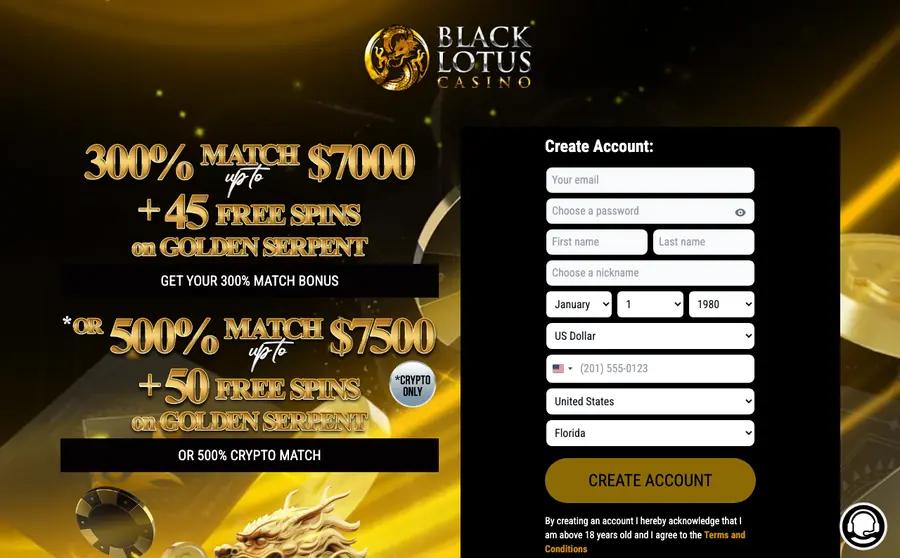
On a limited mobile connection, read the full bonus and cashier screens before depositing rather than relying on a saved summary later. The welcome choice is 500% up to $7,500 with crypto or 300% up to $7,000 with conventional currency, using code BLACK500MB. The minimum deposit is $20, and 50 free spins are listed. The 60x wagering requirement is heavy, meaning withdrawals can remain restricted until substantial play is completed.
The published summary does not state mobile-specific account limits, eligible spin games, spin value, contribution rates, maximum bonus bets, expiration, or exactly which deposit source receives which percentage. It also does not explain whether the single documented code applies to both routes or how incomplete wagering affects a requested payout.
This suits a player deciding between crypto and conventional funding who prioritizes a high ceiling and can tolerate prolonged wagering on a portable device. It does not suit someone seeking easy bonus clearance, or anyone whose limited connection makes it difficult to preserve term details and transaction confirmations.
What stands out
- 500% crypto match up to $7,500
- 300% conventional-currency match up to $7,000
- 50 free spins and a $20 minimum
Check before you deposit
- Confirm which funding route the code activates
- Check whether spin winnings carry 60x
- Welcome offer
- 500% up to $7,500 (crypto); 300% up to $7,000 (fiat)
- Minimum deposit
- $20
- Wagering
- 60x
- Free spins
- 50
- Bonus code
- BLACK500MB

Lucky Creek
The crypto and conventional options are large, but the $50 minimum and 60x wagering narrow the audience.
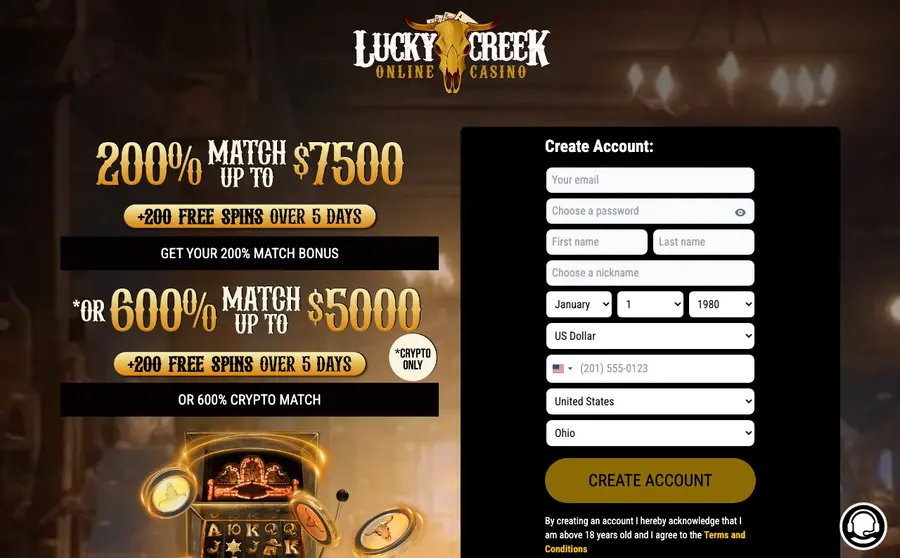
A large win may not be released in a single payment if withdrawal limits or staged approvals apply, and the published summary does not specify either. Welcome choices are 600% up to $5,000 with crypto or 200% up to $7,500 with conventional currency, plus 200 free spins. The minimum deposit is $50, and the listed wagering is 60x. That multiplier materially delays withdrawal of bonus-related funds regardless of which funding route you choose.
The published terms do not state how withdrawals are capped or scheduled, how the 200 spins are allocated, their eligible games or value, whether spin winnings join the 60x requirement, or which account route has precedence when both options appear. They also leave verification timing and payout method restrictions unstated.
This suits a higher-deposit player choosing between a larger crypto percentage and a larger conventional-currency ceiling, provided extended playthrough is acceptable. It does not suit a small bankroll, someone expecting fast bonus clearance, or anyone uncomfortable depositing before payout limits and verification requirements are confirmed.
What stands out
- 600% crypto match up to $5,000
- 200% conventional match up to $7,500
- 200 free spins
Check before you deposit
- Check payout limits before a large win
- Confirm whether spin winnings carry 60x
- Welcome offer
- 600% up to $5,000 (crypto); 200% up to $7,500 (fiat)
- Minimum deposit
- $50
- Wagering
- 60x
- Free spins
- 200
Shazam
A documented first-deposit code is helpful, though the broader package structure remains underexplained.

The stated terms cover the basics plainly: a 260% first-deposit match up to $2,600, a broader welcome package valued up to $7,500, a $25 minimum deposit, 35x wagering, 40 free spins, and code WINWAY. In practical terms, bonus-linked funds cannot simply be withdrawn after deposit; they remain restricted until the listed playthrough and any additional eligibility rules are completed.
What the published summary leaves unstated is how the larger package divides beyond the first deposit, whether later stages use the same code, which games carry the 40 spins, or how spin winnings are treated. It also does not identify contribution rates, maximum wagering bets, expiration, or any withdrawal cap attached to either part of the offer.
This suits a player who at least wants the first-deposit percentage, code, and multiplier documented before opting in. It does not suit someone who needs the full $7,500 package broken down in advance, or anyone who treats an aggregate package figure as established value without knowing the later-deposit mechanics.
What stands out
- 260% first match up to $2,600
- WINWAY code is published
- 40 free spins
Check before you deposit
- Ask how later package deposits are divided
- Check spin eligibility and any withdrawal cap
- Welcome offer
- 260% up to $2,600 (first deposit); $7,500 full Welcome Package
- Minimum deposit
- $25
- Wagering
- 35x
- Free spins
- 40
- Bonus code
- WINWAY

BetWhale
Separate casino and sports welcome tracks provide choice, but cashier-route details still need confirmation.

The verified terms do not explain how crypto and conventional banking compare, so inspect the cashier before selecting either route. The casino welcome is 250% up to $2,500 with code BUFFALOWHALE, while the sports welcome is 200% up to $6,000 with code POWERDRIVE. The minimum deposit is $20, 50 free spins are listed, and casino wagering is 30x. That multiplier means the bonus must be played through before its value can be requested for withdrawal.
The published summary does not distinguish method-specific limits, processing rules, or eligibility between crypto and conventional payments. It also does not state spin-game eligibility, spin value, game contribution, maximum wagering bets, the sports offer's settlement mechanics, or whether either code can be reversed after use.
This suits a player who wants distinct casino and sports promotions and will compare the cashier choices before committing. It is less suitable for someone who expects payment-method treatment to be obvious from the headline offer, or for anyone likely to enter a promotional code without first confirming its product-specific conditions.
What stands out
- 250% casino match up to $2,500
- 200% sports match up to $6,000
- Both product codes are published
Check before you deposit
- Compare cashier methods before choosing
- Check the sports offer's settlement mechanics
- Welcome offer
- 250% up to $2,500 (Casino); 200% up to $6,000 (Sports)
- Minimum deposit
- $20
- Wagering
- 30x
- Free spins
- 50
- Bonus code
- BUFFALOWHALE (Casino); POWERDRIVE (Sports)

VoltageBet
Balanced dual welcome offers are easier to size than oversized matches, though both still carry defined conditions.
The distinguishing feature is a pair of balanced 100% offers rather than one very large percentage headline. The casino offer is 100% up to $1,000 using POWERUP, and a separate sports welcome is also listed at 100% up to $1,000. The minimum deposit is $20, and casino wagering is 30x. That means casino bonus value remains restricted until playthrough and all attached eligibility requirements have been completed.
The published summary does not provide a sports-specific code or explain the exact mechanics of that sports format. It also does not state whether casino wagering applies to bonus alone or deposit and bonus, which games contribute, whether maximum bets are capped, or how verification and payout approval affect the first withdrawal.
This suits a player who prefers more moderate caps and a choice between casino and sports while using a documented casino code. It does not suit someone seeking a very high multiplier-style match, and it is a poor fit for anyone who assumes that a sports welcome or a 100% casino match avoids wagering and withdrawal conditions.
What stands out
- 100% casino match up to $1,000
- Separate 100% sports offer up to $1,000
- POWERUP code is published
Check before you deposit
- Ask how the sports offer settles
- Confirm the 30x wagering base
- Welcome offer
- 100% up to $1,000 (Casino); 100% up to $1,000 Risk-free Bet (Sports)
- Minimum deposit
- $20
- Wagering
- 30x
- Bonus code
- POWERUP (Casino)
Frequently asked questions
Is it legal to play at an online casino from Alaska?
Alaska does not license online casinos, so the online casinos open to Alaska players are offshore operators licensed in their own jurisdictions. Alaska law targets the operation of gambling enterprises and provides no licensing route for online casinos. The clearly legal gaming available in Alaska is the charitable gaming described on this page, some of which permit holders may conduct online.
How old do you have to be to gamble in Alaska?
Alaska gambling age limits vary by activity: bingo is 19 and up, while Calcutta pools and Nenana Ice Classic tickets require 18 or older. Offshore casino sites set their own minimum ages in their posted terms, so confirm the age requirement on each individual site before you play.
Does Alaska have a lottery?
No, Alaska has no state lottery, though its charitable gaming law does let permitted municipalities and qualified organizations run their own raffles and lotteries. That is why the word lottery appears in Alaska statutes, but there is no state-run lottery selling tickets to the public.
What is the Nenana Ice Classic?
The Nenana Ice Classic is a guessing contest written into Alaska state law at AS 05.15.690(27): each ticket is a guess at the time the ice moves on the Tanana River at Nenana, and the closest guess wins the jackpot. For 2026 the jackpot was $144,749 with a winning time of May 4 at 6:58 PM, and buyers must be 18 or older.
Does Alaska tax gambling winnings?
No — Alaska has no state personal income tax, so Alaska takes no state tax on gambling winnings. Gambling winnings remain taxable income at the federal level, and offshore sites do not withhold or report for you, so keep your own records and confirm details with a tax professional.
What happens if an offshore casino site refuses to pay?
If an offshore casino site refuses to pay, begin with the site's own support process in writing and keep your account and transaction records. If that stalls, use the dispute process in the operator's licensing jurisdiction, which the better-licensed operators publish. That is why this page's assessment criteria weight payment track record and verifiable licensing so heavily.
Are pull-tabs legal in Alaska?
Yes — pull-tab games are expressly listed in AS 05.15.100(a) among the activities a permitted municipality or qualified organization may conduct. They are a common charitable gaming product across Alaska, sold under the permit system to raise money for the permit holder's purposes rather than as a commercial offering.
Can you run a raffle online in Alaska?
Yes — you can run a raffle online in Alaska, but only after obtaining the required charitable gaming permit. Under AS 05.15, a permittee, operator, or holder of a multiple-beneficiary permit may conduct the raffle or lottery over the Internet and draw winning tickets online. That authority belongs to permitted municipalities and qualified organizations, and the route is a permit from the Alaska Department of Revenue, Tax Division.
Are there casinos you can drive to in Alaska?
No — Alaska has no commercial casinos, so there is no casino floor to drive to anywhere in the state. The in-person gambling that exists is charitable gaming under the permit system, such as bingo halls and pull-tab sales run by permit holders, while the nearest commercial casinos are in other states.
Where can I get help with a gambling problem in Alaska?
In Alaska you can call or text the National Problem Gambling Helpline at 1-800-GAMBLER, which is free, confidential, and available around the clock. The National Council on Problem Gambling at ncpgambling.org also offers screening tools and phone-based or online support, which is effective from anywhere you can get a phone signal.